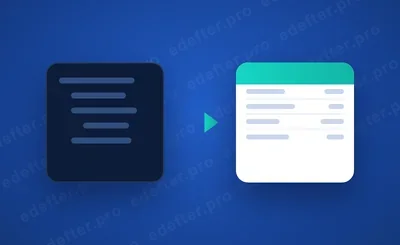

The e-Ledger berat is an electronic file that carries not the financial records of the electronic ledger but only its summary and signature value, sealed with GİB's (the Revenue Administration's) financial seal. It is not the ledger itself. Its function is to prove that the ledger existed on a given date and has not been changed since. It is the electronic equivalent of notary certification on a paper ledger. The berat approves not the content of the ledger but its integrity.
Author: e-Defter PRO Content Team. The team that runs the berat production and approval process for hundreds of taxpayers each month.
Last month a client called. Their computer was about to be replaced, and they saw no harm in deleting the ledger files. "I already downloaded the GİB-approved berat, my ledgers are with the state," they said.
They were not.
The general ledger file never goes to GİB. The berat is not the ledger, it is its summary. Had those files been deleted, the taxpayer would have had no ledger left in the event of a presentation request. Confusing the berat with the ledger is the most common, and the riskiest, misconception we see. In this article we clarify what the berat is from the very start. If you do not want to skip the basics, our guide on what e-Ledger is is a good start.
What You Need to Know
- The berat is not the ledger itself, but its electronic summary sealed with GİB's financial seal.
- The ledger's financial records are not inside the berat. It holds only the signature/seal value, company and accountant details, ledger type and period.
- A separate berat is produced for the journal and for the general ledger.
- Without obtaining the GİB-approved berat, the e-Ledgers are not considered legally valid.
- The berat does not approve the content of the ledger. It only proves its integrity (General Communiqué on the Electronic Ledger, 6.3).
What exactly is an e-Ledger berat?
The e-Ledger berat, by the definition in the General Communiqué on the Electronic Ledger, is an electronic file that contains information conforming to the standards set by the Administration and sealed with the Administration's financial seal. In short, it is the summary of the ledger, not the ledger itself. It does not carry all of the ledger's journal entries and amounts.
We explain the berat best with an analogy. The berat is not a photocopy of the ledger, it is its fingerprint. The signature value inside it is a key used to match the ledger with the berat. So the berat proves the identity of the ledger and that it has not changed in that state, but it does not copy its content.
Why does this distinction matter? Because a taxpayer who mistakes the berat for the ledger may neglect the actual ledger files. Yet legal validity depends on keeping the ledger itself, its berat and the GİB-approved berat together. All three must stay side by side.
What is inside the berat?
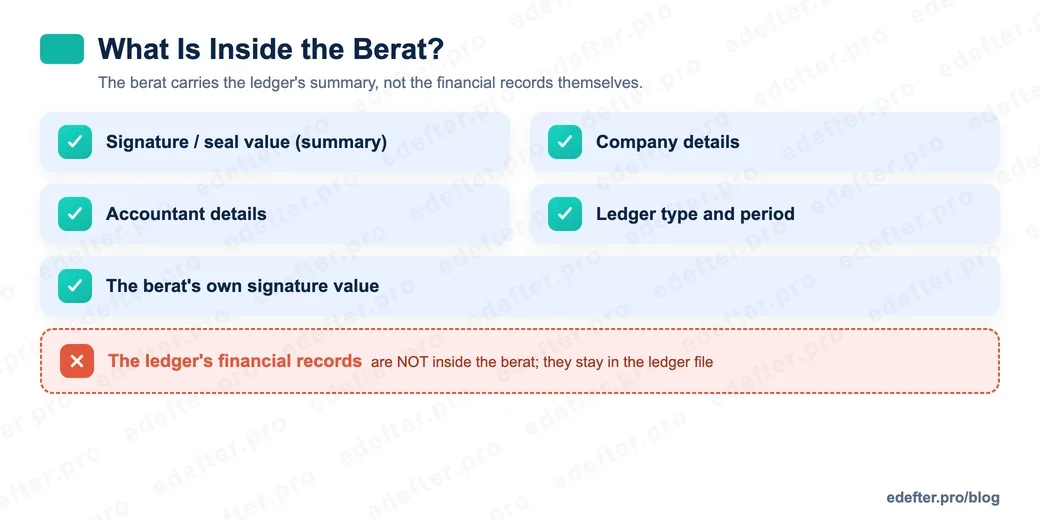
The ledger's financial records are not inside the berat. The e-Ledger Application Guide states this clearly: the berat carries some summary information, excluding the financial records of the ledger. So journal entries, amounts and account movements are not inside the berat, they stay in the ledger file.
So what does the berat carry? The following details:
- The ledger's signature or seal value, that is, the summary key matching the ledger and the berat.
- Company details.
- Accountant details.
- The type and period of the ledger produced.
- The berat's own signature value.
This list shows why the berat cannot take the place of the ledger. The berat is like an identity card: it identifies you but does not stand in for you. The ledger files stay with the taxpayer.
What is the difference between the e-Ledger and the berat?
The e-Ledger and the berat are two separate files that complete each other. The ledger is the main record holding all financial entries, and it stays with the taxpayer. The berat is the GİB-approved summary of that ledger. The most critical difference between them is what goes to GİB. The table below puts the two side by side.
| Criterion | e-Ledger (file) | Berat |
|---|---|---|
| Content | All journal and account entries | Summary, signature/seal value |
| Where it stays | With the taxpayer | With the taxpayer + GİB approval returns |
| Does it go to GİB | Journal does; general ledger does not | Journal and general ledger berat go |
| Function | The record itself | Proof of integrity and existence |
There is an important update after 2025 here. For January 2025 and later periods, the general ledger file itself is not uploaded to GİB. Only the journal, the journal berat and the general ledger berat go to GİB. The general ledger itself stays with the taxpayer from start to finish. That was exactly where our client from the opening went wrong.
Is a separate berat produced for the journal and the general ledger?
Yes, a separate berat is produced for the journal and for the general ledger. Two ledgers are created each period, so two berats come out. Treating them as a single file leads to incomplete processing at upload.
In practice this means the following. When closing a period, you must make sure a berat is produced on both the journal and the general ledger side. e-Ledger software prepares these two berats together, but the check is always the taxpayer's responsibility. A missing berat puts that ledger's validity at risk.
How is a berat produced and approved?
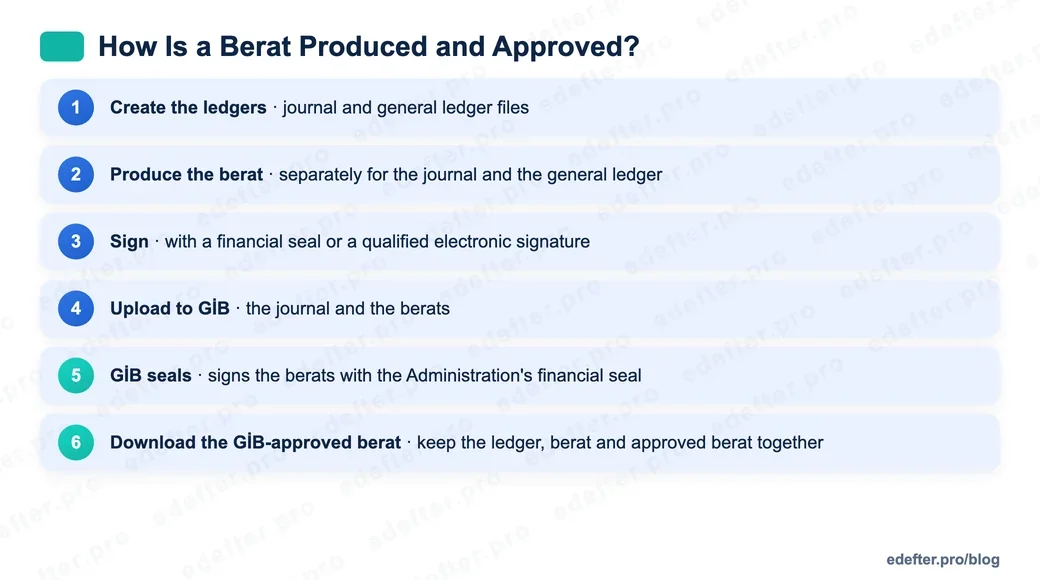
The berat is produced after the ledger is created, then signed, uploaded to GİB, and sealed and returned by GİB. The process runs through a few steps, and the ledger is not considered valid until the last step is complete. The flow is as follows.
- The journal and general ledger files are created.
- A berat file is produced for each ledger.
- The berats are signed with a financial seal or a qualified electronic signature.
- The journal and the berats are uploaded to GİB.
- After a check, GİB signs the berats with its own financial seal.
- The taxpayer downloads the GİB-approved berat and keeps the ledger, the berat and the GİB-approved berat together.
The upload deadlines, preference and consequences of delay are a separate topic. We cover them in our e-Ledger berat upload guide. You can also find the current calendar on our submission deadlines page.
What does the GİB-approved berat do?
The GİB-approved berat is the berat uploaded by the taxpayer, sealed and returned by GİB, and it is the condition for the ledger's legal validity. The Application Guide says it plainly: unless the GİB-approved berat file is obtained, the created e-Ledgers are not considered legally valid. So producing a berat alone is not enough, GİB's approval must come back.
Let us correct a common mistake here. GİB's berat approval does not approve the content or accuracy of the ledger. The Communiqué states this openly: the berat is intended to prove the integrity of the e-Ledgers, not to approve their content. The approval does not mean a check of the accuracy of the entries either. GİB does not say "this ledger is correct," it says "this ledger existed on this date and has not changed since."
What are the opening and closing approvals?
The opening and closing approvals are the special names of the berats for the first and last months of the accounting period. According to the Communiqué, the berat obtained for the first month of the accounting period counts as the opening approval, and the one for the last month as the closing approval. So it is not a separate transaction, but the additional function those months' berats take on.
If you recall from the paper world, ledgers were certified at a notary at the start and end of the year. In e-Ledger, the berats take the place of that certification. The first month's berat represents the opening, the last month's the closing. This way the start and end of the period are sealed electronically.
Am I required to keep the berats?
Yes, keeping the e-Ledger files and their berats together, related to each other, is a legal obligation. The Communiqué requires the ledger and berat files to be preserved and presented together. A missing one creates a serious gap at the moment of presentation.
Let us add a warning on the storage side. Some taxpayers, knowing that secondary copies are kept in a storage service, underestimate their own obligation. Yet the storage service does not remove the taxpayer's core duty to preserve and present. That was the gist of the opening phone call: deleting the ledger files because the berat was approved at GİB leaves you defenceless at presentation. At e-Defter PRO we keep the ledger, the berat and the GİB-approved berat together, related to one another.
In Short
To sum up the berat in one sentence: not the ledger itself, but its GİB-approved fingerprint. Always keep your ledger, its berat and the GİB-approved berat together. If you are curious about the upload deadlines, see our berat upload guide. If you are unsure about your situation, talk to our expert team.