Once e-Ledger files are produced, they must be kept for a set period and produced on request. For commercial ledgers the Turkish Commercial Code sets a ten year preservation duty, while on the tax side the Tax Procedure Law generally sets a five year preservation and production duty. Keeping these files and producing them in full on request is the taxpayer's responsibility. The ledger and berat are produced and sent to GİB (Turkey's Revenue Administration); but the separate "secondary copy" step that used to go to GİB was removed in 2024. In short, no authority archives your files on your behalf; storage and production are directly yours.
Author: e-Defter PRO Content Team. The field team that walks with taxpayers through the storage and production of e-Ledger files.
A taxpayer called in a rush last year. An old period's ledgers had been requested, but the computer holding the files had changed, and no backup was taken.
The files were lost. All of them.
This scenario is the price of treating storage as a detail to think about later. Yet storage is as much a part of the process as producing the ledger. This article explains how long, where and by whom an e-Ledger is kept. You can find the general frame of e-Ledger in our what is e-Ledger guide.
What You Need to Know
- e-Ledger files are kept for a set period and produced on request.
- The duration depends on two frameworks: ten years on the Commercial Code side, generally five years on the tax side.
- Keeping and producing the files is the taxpayer's responsibility; the ledger and berat are sent to GİB for the berat process.
- The old "secondary copy" step was removed by Communiqué No. 4 (21 May 2024); GİB does not archive your files on your behalf.
- The storage responsibility is the taxpayer's; software or a service eases it but does not remove it.
How long is an e-Ledger kept?
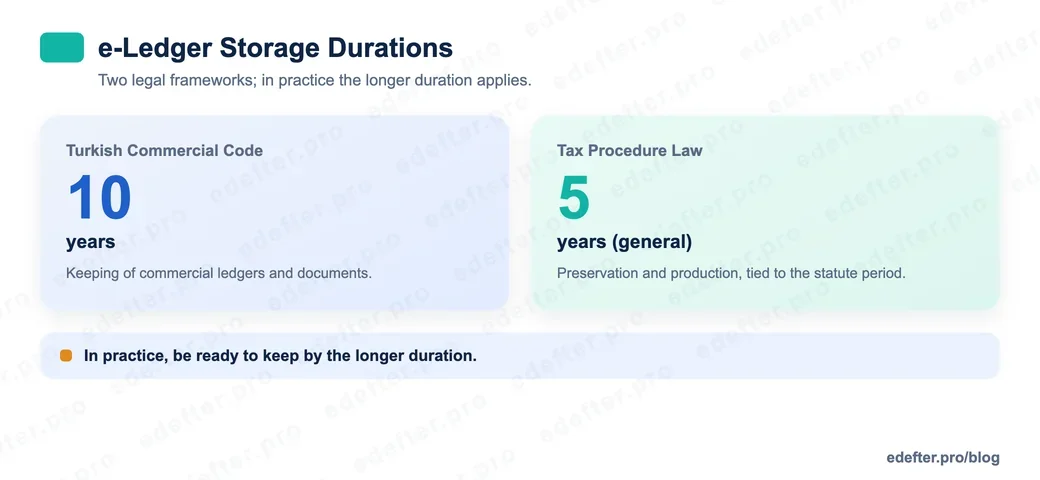
The storage duration of e-Ledger files cannot be reduced to a single number, because two different legal frameworks come into play. The Turkish Commercial Code sets the keeping of commercial ledgers and documents for ten years. On the Tax Procedure Law side, the preservation and production duty is generally tied to the five year statute period.
In practice, businesses act by taking the longer of the two durations. Plan for the long one. So it is best to be ready to keep your ledgers safely for years. During that period the files do not just sit; they must stay readable and producible on request.
The key concept here is preservation and production. Preservation is keeping the file without corruption. Production is being able to present the file in full when an authority asks. Two duties, not one. If both are not met together, storage does not reach its purpose.
Where are e-Ledger files kept?
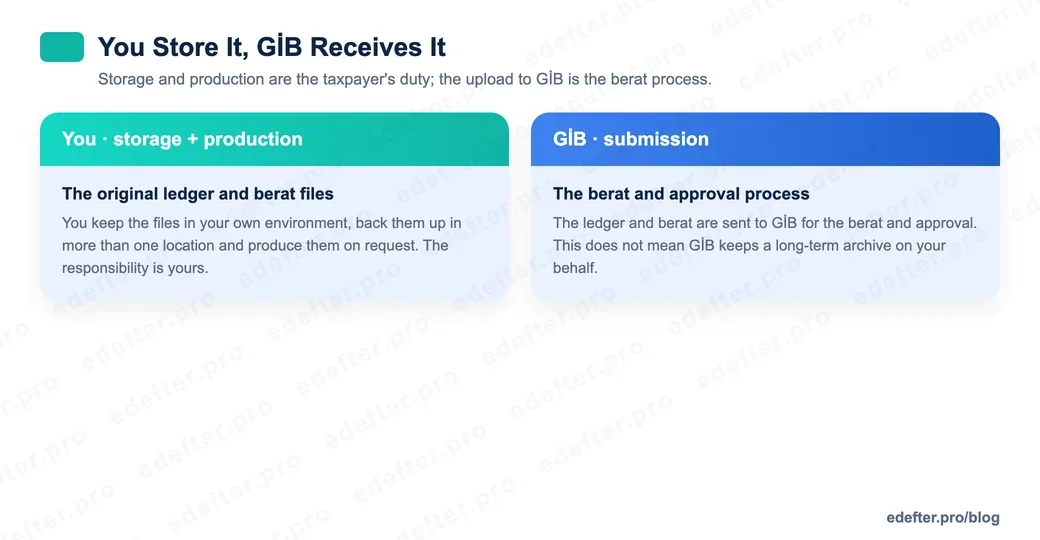
The original ledger and berat files sit in the form you produced them, in your own environment. Keeping them safely, backing them up regularly and producing them on request is your responsibility. The ledger and berat are also produced and sent to GİB; but this submission is for the berat and approval process. It does not mean GİB keeps a long-term archive on your behalf.
This split became clearer in 2024. There used to be a separate storage step called a "secondary copy" in GİB systems; that step was removed. So the safety of your files is directly in your hands. If your file stays tied to a single computer, the loss risk is high, so a regular backup is a must.
How this picture changed in 2024, that is why the old "secondary copy" step went away, we take up right below.
How did the secondary copy rule change?
You see the term "secondary copy" often in older sources. The concept described keeping a copy of the e-Ledger and berat files in GİB systems or at an authorized storage provider. With Communiqué No. 4 amending the Electronic Ledger General Communiqué (Official Gazette, 21 May 2024), the word "secondary" was removed from the communiqué text; the phrase "their secondary copies" was changed to "the copies".
What this means in practice is that a separate "send a secondary copy" step was simplified. For example, the separate upload of general ledger (defter-i kebir) files was ended; the ledger and berat reach GİB within the standard submission. It has one more consequence. The safety of the files now rests entirely on your own backup and archive plan, not on a separate GİB step. Because the scope and steps are updated from time to time, we suggest you confirm the current process for your own period from GİB's e-Ledger Storage Guide.
What does not change is fixed: the responsibility to preserve and produce the original files stays with the taxpayer. Even if the term and the step change, the duty to present your ledger in full on request is yours.
Who holds the storage responsibility?
The storage responsibility is clearly on the taxpayer. Not the accountant. Not the provider. Even if your accountant produces the ledger and a service provider runs the submission, the duty to preserve and produce the files throughout their period belongs to the taxpayer. This is the same responsibility principle we meet at many steps of e-Ledger.
The way to manage this responsibility is to plan storage from day one. You need to know where the files are kept, who has access, that the upload to GİB was done and that your own backup was taken. The storage and archive side is usually offered as a separate service; so when choosing software or a service, clear up whether this side is in the scope. We gathered what to look at in software selection in our how to choose e-Ledger software article.
What happens if the files are lost?
The loss of files or the failure to produce them is a serious problem. A taxpayer who cannot present the ledger on request loses the power of proof, and can face an administrative sanction on top of that. One copy, no backup. As in the example at the start, that is the most fragile scenario there is.
The way to protect is clear. Back up the original files in your own environment regularly, keep copies in more than one location and hold access to the files under control. A hardware change or a fault does not turn into data loss in a storage setup built right. Do not set it up once and forget it. Check periodically that the backup and the access still work.
How does backup and storage work in e-Defter PRO?
We were designed to run this for you. The regular backup and multi-location storage described above, without asking a separate effort from you. In e-Defter PRO, automatic backup is offered as a separate service and kicks in on its own once the ledger submission is complete. No button to press. After each submission your files are kept in three different locations, so you do not stay tied to a single computer or a single copy.
What does this mean in practice? The loss scenario the taxpayer at the start lived through goes away. The hardware changes, or one copy is damaged, and a backup of your files still waits ready in the other locations. The burden of taking backups by hand, tracking copies and hunting for what is where lifts off your shoulders. The legal preservation and production responsibility still stays with you; we take on the operational load of it. The storage packages are offered inside the e-Defter PRO application, not on the site's packages page; you see their scope and options through the app.
In Short
In e-Ledger, storage is as much a part of the process as producing the ledger. Plan the duration by the longer framework, back up your original files in more than one location, and do not forget that storage and production are yours. If you want us to set up storage and production safely for you, talk to our expert team; the storage packages sit inside the e-Defter PRO application.