
Keeping an e-Ledger without a financial seal usually points to two routes: real persons signing with a qualified electronic signature, or submission through an intermediary's seal via a muvafakatname (an authorisation). For legal entities, a financial seal is mandatory to sign the ledger and the berat; the muvafakatname does not remove that seal, it only sets who uses it. The application can be made without a seal, but signing the ledger requires a seal or an electronic signature.
Author: e-Defter PRO Content Team. The team that runs e-Ledger signing methods for real-person and legal-entity taxpayers each month.
Last month a new taxpayer called. They had just moved to the balance-sheet basis, and they were tense. "There will be a financial seal cost too, I suppose," they said.
There was not.
They were a real person and already held a qualified electronic signature. They could sign their e-Ledger with it. No seal needed. That is usually exactly what "e-Ledger without a financial seal" means. In this article we clarify the concept from three angles: real person, legal entity, and the muvafakatname. For the basics, see our guide on what e-Ledger is.
What You Need to Know
- Real persons can sign the e-Ledger with a qualified electronic signature (NES) instead of a financial seal; no seal is needed.
- For legal entities, a financial seal is mandatory to sign the ledger and berat. A muvafakatname does not remove this.
- A muvafakatname lets a taxpayer's ledger and berat be submitted with the seal or signature of an intermediary (a private integrator, a compliant software firm, or an accounting professional).
- A muvafakatname does not transfer legal and criminal responsibility to the intermediary. The responsibility stays with the taxpayer.
- A sealless application is possible, but sealless signing is not. The application and the signing are two separate steps.
Is an e-Ledger without a financial seal possible?
An e-Ledger without a financial seal is possible when defined correctly, but it does not mean "with no seal and no signature at all." The concept covers two situations. The first is real persons using a qualified electronic signature instead of a financial seal. The second is submission through an intermediary's seal via a muvafakatname.
The most common misconception here is reading "sealless" as "signatureless." For an e-Ledger file to be legally valid, it must be approved with either a financial seal or a qualified electronic signature. A file produced with neither does not count as an e-Ledger. So the question is not "can it be done with no approval," but "can it be done without my own financial seal."
The answer depends on the taxpayer type. The table is different for a real person and a legal entity. We open both below.
Can a real person keep an e-Ledger without a financial seal?
Yes, real-person taxpayers can keep an e-Ledger without obtaining a financial seal. The route is the qualified electronic signature. A real person who holds a valid e-signature can make the e-Ledger application and sign their ledgers with it. No separate financial seal is required.
That was exactly our client's situation from the opening. Real-person taxpayers, such as the self-employed or sole proprietors, often use the e-signature they already hold for other transactions in e-Ledger too. This removes both a cost item and a separate procurement step.
For legal entities the situation is different, and we clarify it in the next section. In short: for companies, the financial seal stays mandatory at the signing step.
What is a muvafakatname, and what does it do?
A muvafakatname is an authorisation document by which the taxpayer permits an intermediary to sign and upload the e-Ledger and berat files. It rests on the muvafakatname and power-of-attorney provision of the General Communiqué on the Electronic Ledger. With this permission, the taxpayer can have the work done not with their own seal, but with the seal or signature of the party they authorise.
The parties that can be authorised are defined: private integrators, firms with compliance approval, and accounting professionals under Law No. 3568, that is SMMMs and YMMs. The muvafakatname is granted by the taxpayer through the Digital Tax Office. For a given period, either an accounting professional or a software firm is authorised, not both at once.
The practical benefit is this. Especially in accounting offices serving many taxpayers, the need to attach and detach a separate seal for each taxpayer disappears. The signature is applied with the authorised party's seal. This is why at e-Defter PRO we support sealless submission via a muvafakatname.
Does a muvafakatname remove responsibility?
No, a muvafakatname does not remove legal and criminal responsibility. This is the most critical point of the article, and the most misunderstood one in the field. Even if the taxpayer authorises an intermediary to sign and upload the ledger and berat, the responsibility arising from these actions stays with the taxpayer.
So even when an SMMM or a private integrator submits via a muvafakatname, the administrative responsibility from a late or faulty berat belongs to the taxpayer. A muvafakatname is a convenience tool, not a transfer of responsibility. Knowing this distinction upfront prevents the later "but I gave authority, so it is on them" disputes.
There is a second limit too. Ledgers and berats for months, years or accounting periods not stated in the muvafakatname must be signed with the taxpayer's own qualified electronic signature or financial seal. The authority is valid only for the periods it covers. A period outside the scope does not automatically fall to the intermediary.
Is a sealless application the same as sealless signing?
No, a sealless application and sealless signing are different things and should not be confused. With the Communiqué Serial No. 5 on the Electronic Ledger, dated 8 November 2024, taxpayers became able to apply for e-Ledger through the Digital Tax Office with a username and password, without using a financial seal or an electronic signature. This eased the application step only.
Creating and signing the ledger and berat is a separate step, and the rule does not change there. For a legal entity a financial seal, and for a real person a qualified electronic signature or a financial seal, is still mandatory. If a muvafakatname is granted, the signature is applied with the intermediary's seal. In short, the application door can open without a seal, but signing the ledger cannot be completed without a seal or a signature.
We stress this because of a disappointment we see often in the field. The taxpayer thinks "I applied without a seal, so I will never need one," and then sees at the signing step that a seal or signature is required. You can find our application walkthrough in the how to apply for e-Ledger guide.
Which method suits whom?
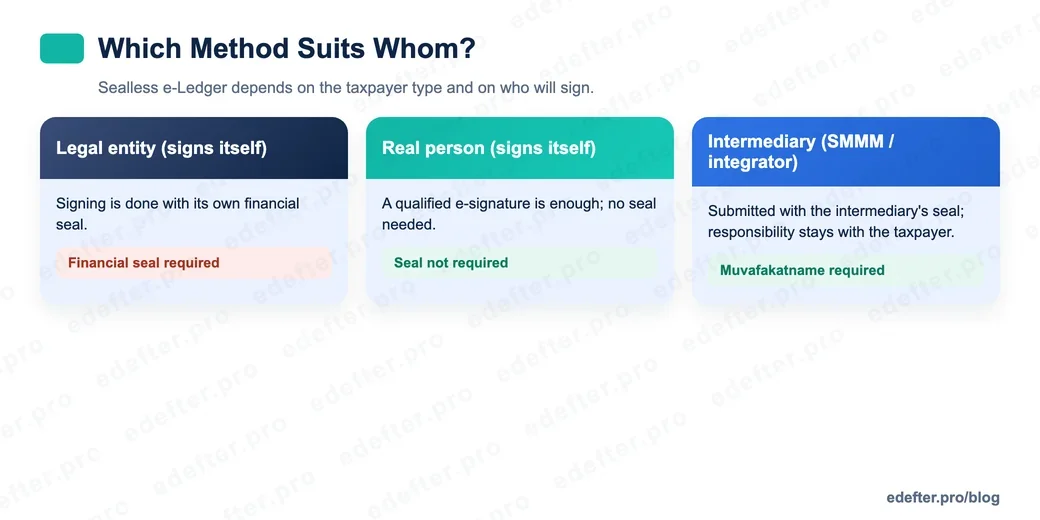
The right method depends on the taxpayer type and on who will sign. The table below sums up three typical situations. Find your own case in it and settle the method.
| Situation | Application | Signing | Own financial seal required? |
|---|---|---|---|
| Legal entity, signs itself | Can be done sealless | Own financial seal | Yes |
| Real person, signs itself | Can be done sealless | Qualified e-signature or financial seal | No, e-signature is enough |
| Intermediary (SMMM or integrator) | Can be done sealless | Intermediary's seal or signature | No, but a muvafakatname is required |
The summary of the table is this. If you are a real person with an e-signature, you can carry on without a seal. If you are a legal entity, the seal is needed for signing. If you work with an intermediary, you use the muvafakatname route, but your responsibility continues. If the berat concept is unfamiliar, our guide on the e-Ledger berat helps.
Choose the Right Method
In short: for a real person the e-signature is enough, for a legal entity the seal is needed for signing, and in an intermediary case the muvafakatname is in play but the responsibility is yours. First settle your taxpayer type and who will sign, and the method becomes clear on its own. If you are unsure, talk to our expert team and we will assess it together.