


XBRL GL is the international accounting data format that e-Ledger uses. It stands for eXtensible Business Reporting Language Global Ledger; in short, an XML structure that carries general accounting records with standard tags. It stores journal and general ledger records, each amount, account code and date, by tagging them one by one, in a form that machines can read, validate and check for integrity. That is why your e-Ledger files do not read by eye. They are built for machines.
Author: e-Defter PRO Content Team. The field team that produces and validates e-Ledger files in XBRL GL format.
A taxpayer opened his file last month and said "what a mess". His screen showed text full of tags. It did not look like an accounting ledger.
It was not meant to.
That file was in XBRL GL format, written for systems, not for the human eye. This article explains why e-Ledger uses this format, how its structure works and how it differs from the e-Invoice format. You can find the general frame of e-Ledger in our what is e-Ledger guide.
What You Need to Know
- XBRL GL is an international XML format that carries accounting records with standard tags.
- e-Ledger produces the journal and general ledger in this format; GİB (Turkey's Revenue Administration) adopted it.
- The format is machine readable, so a double click does not turn the file into readable text; a viewer is needed.
- XBRL GL carries ledger records, UBL-TR carries the e-Invoice document; the two are built for different purposes.
- A file produced in a non compliant format is not a valid e-Ledger; the format is not a detail, it is a validity condition.
What is XBRL GL?
XBRL GL is an XML format that holds accounting data in an international standard and in a tagged structure. The XBRL part of the name refers to an open standard built for business and financial reporting. The GL part means Global Ledger, that is the general accounting ledger, and shows that the format focuses on ledger records.
The core idea is this. Every piece of accounting data is marked with a tag. In a journal entry, the date, the account code, the debit and credit amount, the description; each carries its own tag. So the data is not just a pile of text. It becomes a structured record whose meaning is known to the machine.
This structure lets the data move between systems without trouble and be validated automatically. And that is exactly what sits behind e-Ledger's choice of this format.
Why does e-Ledger use the XBRL GL format?
e-Ledger is the electronic and legal form of the journal and general ledger. These ledgers must be kept in a standard, verifiable and unchangeable form. XBRL GL provides exactly this, so GİB adopted it as the data format of e-Ledger.
Being standard means every taxpayer's ledger is produced in the same structure. So GİB can read and check millions of ledgers from different software with the same rules. Being verifiable means the file's compliance with the rules can be checked by machine. Its integrity is then secured by the berat and signing layer.
The conclusion here matters. The format is not a preference or a detail. It is a validity condition of the ledger. A file produced in a non compliant format, however correct its data, is not counted as a valid e-Ledger.
The structure of XBRL GL: tagged data and taxonomy
Two concepts sit at the heart of XBRL GL: tagged data and taxonomy. Tagged data, as we said, is each piece of information carrying its own tag. The taxonomy is the dictionary of these tags; it defines what each tag means and by which rule it is used.
An example makes it clear. A journal entry holds this information: entry number, date, debit and credit accounts, amounts, description. XBRL GL places each of these into a separate tag. The taxonomy then requires these tags to be used in the right order, of the right type and in the right relation.
- An accounting record forms (a journal entry).
- Each field is placed into its XBRL GL tag.
- The taxonomy validates the tags' rules and relations.
- The result is a standard file that GİB can read and check.
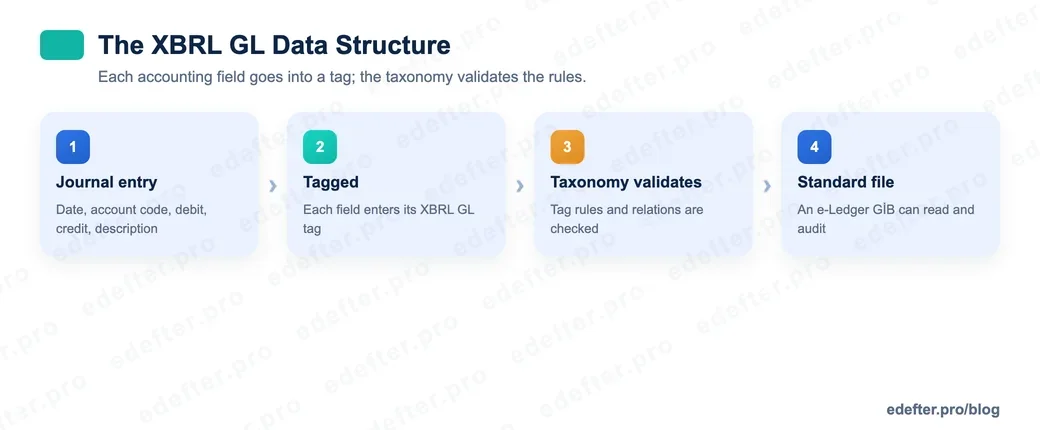
Thanks to this structure, your ledger is not just stored; it can also be checked for consistency. Controls like debit and credit balance, the validity of account codes and the filling of required fields all run over the structure of the format.
Why does XBRL GL not read by eye?
When you double click and open an XBRL GL file, you see not a readable ledger but code full of tags. This is not an error. It is the nature of the format. The tagged structure eases the machine's work, but it is not designed for the human eye.
To make the file readable, a conversion is needed. This conversion is done by GİB's e-Ledger Viewer or the official conversion template. The viewer turns tagged data into tables and shows journal entries in order. We covered the detail in our e-Ledger Viewer guide.
So a file that will not open is not a problem. It is an expected state. With the right tool it reads in seconds.
What is the difference between XBRL GL and UBL-TR?
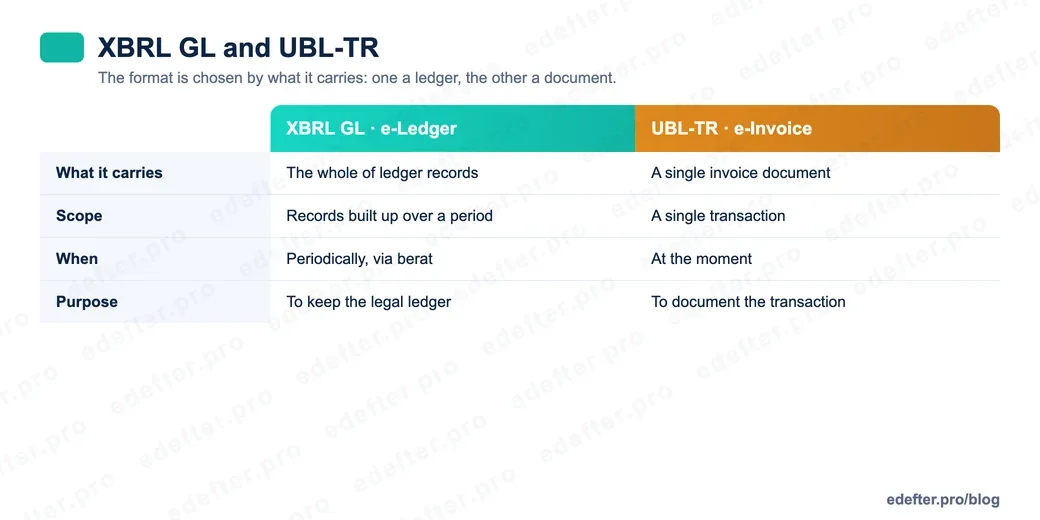
There is a common mix up here. e-Invoice also uses an XML format, but that format is not XBRL GL, it is UBL-TR. The two formats are built for different jobs and should not be confused.
UBL-TR carries a document, that is a single invoice. XBRL GL carries a ledger, that is the whole of all accounting records. One tells a single commercial transaction, the other the records built up over a period. We covered this layer difference between e-Invoice and e-Ledger in our e-Invoice vs e-Ledger article.
In short, the format is chosen by what it carries. Carrying a document, UBL-TR. Carrying a ledger, XBRL GL. e-Ledger carries a ledger, so it uses XBRL GL.
XBRL GL and the berat relationship
The XBRL GL file is the ledger itself; the berat is the summary and approval of that ledger. After the ledger file is produced, a berat that carries a summary of its content is created. This berat is signed and uploaded to GİB, certifying the ledger's existence and integrity.
So XBRL GL and the berat complete each other. The ledger file carries the data. The berat secures that the data existed on a certain date and did not change afterward. You can find what the berat is and how it works in our what is an e-Ledger berat article.
This relationship shows why the format gains meaning together with integrity. XBRL GL standardizes the data. The berat ties that standard to time.
In Short
XBRL GL is the language of e-Ledger. It turns your accounting records into a standard structure that machines can read and validate. The file not reading by eye is a result of this design, not a flaw. And producing the format correctly is the base of your ledger's validity. If you need help on the production and validation side, talk to our expert team.