

e-Ledger is the electronic form of the journal and the general ledger, the books that Turkish businesses are legally required to keep under the Tax Procedure Law and the Turkish Commercial Code. Its difference from a paper ledger is that a GİB-approved berat replaces notary certification to guarantee integrity. The ledger files are produced in the XBRL GL standard and approved with a financial seal or an electronic signature. e-Ledger carries the same legal validity as a paper ledger.
Author: e-Defter PRO Content Team. The team that runs e-Ledger setup and the berat process for hundreds of taxpayers each month.
Last year we were in a first setup call with a client. They had already moved to e-Invoice. Their accountant was relaxed. "e-Ledger is the same thing, we handled that too," he said.
It was not.
e-Invoice is about the sales document. e-Ledger is about the whole accounting record, the journal and the general ledger. Two separate worlds. That day we drew three boxes on the whiteboard: record, approval, proof. The penny dropped. This article draws the same board for you.
For context, Turkey runs a national digital tax system managed by GİB, the Revenue Administration. e-Ledger is one part of it, and it sits close to but apart from e-Invoice.
What You Need to Know
- e-Ledger is the electronic form of the journal and the general ledger, with the same legal value as the paper version.
- Its legal basis is the repeated Article 242 of the Tax Procedure Law (VUK) and the first General Communiqué on the Electronic Ledger, dated 13 December 2011 (Official Gazette 28141).
- Ledgers are produced in the XBRL GL format, approved with a financial seal or a qualified electronic signature, and their berat is uploaded to GİB.
- The berat is a financially sealed electronic summary showing that GİB has approved the ledger. It replaces notary certification.
- According to GİB's 2025 Activity Report, the number of taxpayers using e-Ledger rose from 781,584 at the end of 2024 to 2,192,798 at the end of 2025. It is no longer an exception, it is the mainstream.
What exactly is e-Ledger?
e-Ledger is the electronic form of the books a business must keep, held, stored and presented to GİB electronically rather than on paper. The legal definition rests on the Tax Procedure Law (VUK, Law No. 213) and the relevant articles of the Turkish Commercial Code (TTK, Law No. 6102). In short, the medium of the ledger changes while its legal nature stays the same.
Where does the authority come from? The repeated Article 242 of the VUK gives the Ministry of Treasury and Finance the power to set the rules for creating, transmitting and storing electronic ledgers, records and documents. The first rule issued under that power is the General Communiqué on the Electronic Ledger (Serial No. 1), published in Official Gazette number 28141 on 13 December 2011. It was issued jointly by the Ministry of Finance and the Ministry of Customs and Trade of the time.
The most important point here is one that most definitions skip. e-Ledger is not dumping the ledger into a PDF or an Excel file. It is produced in a specific international data standard, in a structure a machine can read. It is not a printout from your accounting program, it is an electronic ledger shaped by the rules the legislation describes. We will make that clearer in a moment when we cover the format.
How does e-Ledger work?
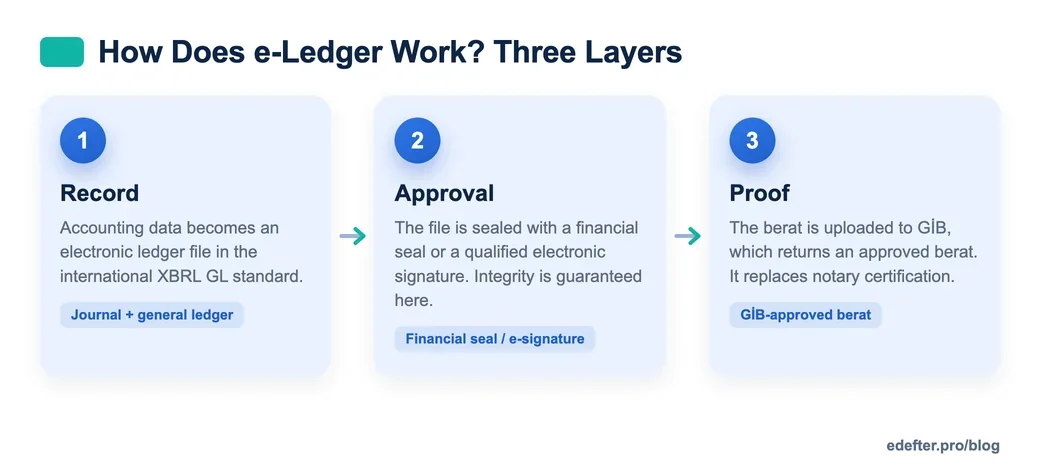
e-Ledger works in three layers: record, approval and proof. In the field, once we separate these three layers the confusion clears, so we will follow the same order here. Each layer answers a different question about the ledger. Record answers "what does the ledger contain", approval answers "does this ledger really belong to you", and proof answers "when did the state see it".
The first layer is the record. The journal and general ledger data in your accounting software is turned into an electronic file in the international standard called XBRL GL. This file is the ledger itself. It holds every journal entry, account movement and amount.
The second layer is approval. The ledger file is sealed with a financial seal or a qualified electronic signature. This step guarantees that the ledger belongs to you and has not been changed afterward. A file without a seal does not legally count as an e-Ledger.
The third layer is proof. The summary of the sealed ledger, its berat, is uploaded to the GİB system. GİB approves the berat with its own financial seal and sends it back to you. That is the moment your ledger is officially certified. The berat takes the exact place of notary certification in the paper world. The whole ledger does not go to GİB, only this approval summary does. The deadlines for uploading the berat are a separate topic that we cover in a dedicated berat upload guide.
Which books are kept as e-Ledger?
The two mandatory books within e-Ledger are the journal and the general ledger. The journal keeps daily entries in date order. The general ledger groups the same entries by account. These two books complete each other, and in the e-Ledger application a separate berat is produced for each of them for every period.
What about the inventory ledger? Here there is an important update for 2026. The inventory ledger is one of the books required under the Tax Procedure Law, but its status on the e-Ledger side is different. According to GİB's announcement dated 13 October 2025, from 1 January 2026 taxpayers within the e-Ledger scope may keep the inventory ledger electronically on an optional basis. It is a choice, not an obligation. Those who wish apply through the Digital Tax Office and move to the e-inventory ledger, and those who do not continue with the paper version.
We stress this distinction for a reason. Many current articles either never mention the inventory ledger or wrongly present it as mandatory. Taxpayers ask about it often. To be clear: for 2026 the journal and general ledger are mandatory, and the inventory ledger is optional in electronic form. Details like this change as the legislation changes, so watch the last-updated date on the page.
What is the difference between e-Ledger and a paper ledger?
The core difference between e-Ledger and a paper ledger is the method of certification and storage. In terms of legal validity, the two are equal. In a paper ledger, opening and closing certification is done at a notary, and the books are stored physically. In an e-Ledger, the berat replaces certification and storage is electronic. Integrity is guaranteed by the financial seal and the electronic signature. The table below puts the two worlds side by side.
| Criterion | Paper ledger | e-Ledger |
|---|---|---|
| Certification | Notary opening/closing certification | GİB-approved electronic berat |
| Creation | By hand or printout | Electronic file in XBRL GL format |
| Integrity | Physical binding, notary | Financial seal / qualified electronic signature |
| Storage | Physical archive (loss, fire risk) | Electronic storage, can be backed up |
| Legal validity | Valid | Equally valid |
| Presentation | Physical delivery | Electronic presentation |
Let us add a field observation. In the paper ledger, the biggest risk was loss and illegibility. A ledger requested years later being damaged by damp or fire was a serious problem. In e-Ledger this risk gives way to a different responsibility: backing up the files and berats regularly. The medium changed, and so did the point that needs care.
Are e-Ledger and e-Invoice the same thing?
No, e-Ledger and e-Invoice are not the same thing, and they are the two most often confused concepts. e-Invoice is issuing and transmitting the invoice between seller and buyer electronically. e-Ledger is keeping the whole accounting record, the journal and the general ledger, electronically. One works at the document level, the other at the ledger level.
There is a link between them, but that link is a sequence, not an equivalence. Because of a turnover threshold, a taxpayer first moves to e-Invoice, and then that move can bring them into the e-Ledger scope. So e-Invoice is often the herald of e-Ledger. That was exactly the misunderstanding of our client from the opening: they thought handling e-Invoice was enough and skipped the ledger side. If you want to know who enters the scope, at what turnover and when, our transition thresholds guide walks through this chain step by step.
What is the difference between e-Ledger and the Defter-Beyan System?
e-Ledger and the Defter-Beyan System (the Ledger-Declaration System) are two separate systems serving different taxpayer groups. e-Ledger is the application where first-class merchants who keep books on the balance-sheet basis keep their journal and general ledger in the XBRL format. The Defter-Beyan System is a record and declaration system set up for taxpayers on the operating-account basis, the self-employed and those under the simple method.
The line between them lies in the taxpayer's basis of bookkeeping. If you are on the balance-sheet basis, you are in the e-Ledger world. If you keep an operating-account book or a self-employment ledger, you are on the Defter-Beyan side. The table below sums up the split.
| Criterion | e-Ledger | Defter-Beyan System |
|---|---|---|
| Who uses it | Balance-sheet basis (first-class merchant) | Operating account, self-employed, simple method |
| Books kept | Journal + general ledger | Operating-account book, self-employment ledger, etc. |
| Format | XBRL GL file | Records in the GİB portal |
| Approval | Financial seal / e-signature + berat | Through the system |
Confusing these two systems leads to wrong applications and needless panic calls. A taxpayer on the operating-account basis trying to apply for e-Ledger, or the reverse, is a mistake we see often in the field. First clarify which basis you are subject to, and the system becomes clear on its own.
Who is required to use e-Ledger?
e-Ledger obligation depends not on a single turnover figure but on several separate criteria. The most common misconception is the assumption that "everyone above a certain turnover keeps an e-Ledger." The reality is more layered. The obligation arises through three main gates: having an e-Invoice obligation, being subject to independent audit, or keeping books on the balance-sheet basis.
The last criterion in particular became decisive after 2025. Taxpayers subject to the balance-sheet basis are within the e-Ledger scope regardless of their turnover. This is a rule that voids much of the "turnover threshold" debate. We gather all the figures, dates and sector exceptions in one table in a dedicated transition thresholds guide. Even if you have no obligation, a voluntary transition is always possible.
How do you move to e-Ledger?
Moving to e-Ledger starts with obtaining a financial seal or a qualified electronic signature and is completed with an application to GİB's e-Ledger application. Legal entities use a financial seal. Real persons can move with a financial seal or a qualified electronic signature. The financial seal is obtained through the TÜBİTAK Public Certification Center.
After that, an e-Ledger software or GİB's own tools come into play. The software converts your accounting records into the XBRL GL format, seals them and manages the berat upload step. We cover the application steps screen by screen in a dedicated application guide. Once setup is done, the real work begins: producing the ledger each period and uploading its berat on time.
At e-Defter PRO we bring these two steps into a single flow. Producing the XBRL GL file from accounting data, sealing it and uploading the berat all move forward on the same screen.
When did e-Ledger start, and how many taxpayers use it today?
The legal framework of e-Ledger was set in 2011, and the first widespread obligation began in 2016. The General Communiqué on the Electronic Ledger (Serial No. 1) was published in 2011. Then the General Communiqué on the VUK (Serial No. 454, 20 June 2015, Official Gazette 29392) brought in the first large group: taxpayers whose 2014 gross sales revenue was 10 million TL or more moved to e-Ledger from 1 January 2016.
Since then the picture has changed completely. According to GİB's 2025 Activity Report, the number of taxpayers using e-Ledger rose from 781,584 at the end of 2024 to 2,192,798 at the end of 2025. Roughly triple in a single year. Behind this jump are the balance-sheet basis rule and the falling turnover thresholds.
This figure shows in the field too. Small businesses that a few years ago thought e-Ledger was "a big-company matter" now ask about it as a routine item on their agenda. It went mainstream. So knowing the answer to "what is e-Ledger" is now the concern of the business owner, not only the accountant. You can always follow current deadlines and dates on our e-Ledger submission deadlines page.
Where Should You Start?
If we sum up e-Ledger in one sentence: it is the legally valid, sealed and GİB-approved electronic form of the paper ledger. First clarify whether you are in the scope. If you are on the balance-sheet basis or you use e-Invoice, this topic concerns you closely. If you are not sure, talk to our expert team and we will assess your situation together.