

e-Ledger has no direct turnover threshold of its own. The obligation arises through three separate gates: having an e-Invoice obligation, being subject to independent audit, or keeping books on the balance-sheet basis. As of 1 January 2025, every taxpayer on the balance-sheet basis is within the e-Ledger scope regardless of turnover. A turnover figure comes into play only when it triggers the e-Invoice obligation, and thereby indirectly e-Ledger.
Author: e-Defter PRO Content Team. The team that plans the transition calendar for dozens of borderline taxpayers each month.
Early this year a manufacturing SME called. Their 2025 turnover had just passed 3 million TL. "We are waiting for e-Invoice in July, we will set up e-Ledger then too," they said. They were calm.
But they had missed something.
They were already keeping books on the balance-sheet basis. So their e-Ledger obligation had already started on 1 January 2025, without waiting for e-Invoice. They had mixed up two different gates. This is the most common mistake we see in the field. Below, we open the three gates one by one. If you are not solid on what e-Ledger is, start with our guide on what e-Ledger is.
What You Need to Know
- e-Ledger has no turnover threshold on its own. The turnover threshold belongs to e-Invoice, and e-Invoice triggers e-Ledger.
- From 1 January 2025, all taxpayers who keep books on the balance-sheet basis are within the e-Ledger scope, regardless of turnover (GİB 2025 e-Ledger transition rule).
- The general e-Invoice threshold is 3 million TL in gross sales revenue for the 2022 and later accounting periods (General Communiqué on the VUK, Serial No. 509).
- A taxpayer above the threshold moves first to e-Invoice (1 July of the following year), then to e-Ledger (1 January of the year after that).
- The Communiqué Serial No. 589, dated 31 December 2025, did not change the e-Invoice or e-Ledger thresholds. It only extended the paper-invoice period for simple-method and operating-account taxpayers by one year.
Does e-Ledger have a turnover threshold?
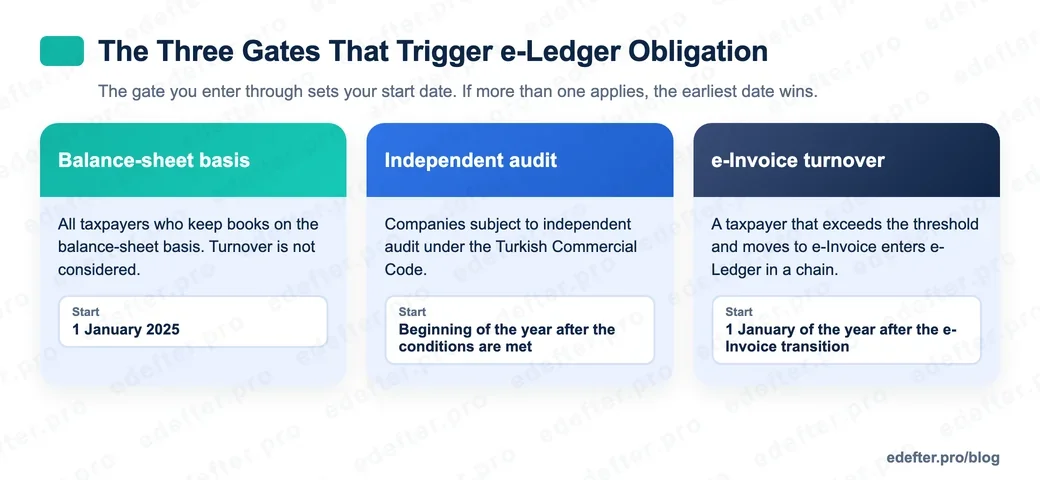
No, e-Ledger has no direct turnover threshold. This is the most common misconception. People think "my turnover passed a figure, so I must keep an e-Ledger." The legislation is not built that way. The turnover threshold is a criterion that determines the e-Invoice obligation. The e-Ledger obligation arises independently, through three separate gates.
These three gates are as follows. First, having an e-Invoice obligation. A taxpayer that moves to e-Invoice enters the e-Ledger scope at the next step. Second, being subject to independent audit under the Turkish Commercial Code. Third, and the most decisive one after 2025, keeping books on the balance-sheet basis.
Why does this distinction matter? Because you cannot calculate your transition date correctly without knowing which gate you entered through. Our client from the opening was looking at the e-Invoice gate, while they had already walked through the balance-sheet gate. Now let us open the gates in order.
Does the balance-sheet basis alone create an e-Ledger obligation?
Yes. As of 1 January 2025, taxpayers required to keep books on the balance-sheet basis are brought within the e-Ledger scope effective from that same date, regardless of their turnover. Those who choose the balance-sheet basis voluntarily are also subject to this rule. This is the most important change, and it voids much of the "e-Ledger turnover threshold" debate in practice.
The result is this. If you are on the balance-sheet basis, being below or above 3 million TL in turnover no longer matters. Your e-Ledger obligation began at the start of 2025. You do not need to wait for the turnover threshold or the e-Invoice calendar, because the gate that brings you into the scope is already open.
For taxpayers who newly start business, switch class to the balance-sheet basis, or lose an exemption, the start is the date that event occurs. This is why in the field we first ask "on which basis do you keep your books". If the answer is the balance-sheet basis, the rest is usually clear.
How does e-Invoice turnover trigger e-Ledger?
e-Invoice turnover triggers e-Ledger not directly but in a chain. A taxpayer whose gross sales revenue exceeds the threshold moves to e-Invoice first. Because they move to e-Invoice within the year on a mandatory basis, they must also move to e-Ledger from the start of the following year. In other words, a one-year lagged ladder comes in between.
Let us see this ladder with a concrete example. Say your 2025 accounting-period turnover exceeded 3 million TL. Your e-Invoice obligation begins at the start of the seventh month of the following year, that is 1 July 2026. Because you moved to e-Invoice within the year, your e-Ledger obligation begins at the start of the year after that, that is 1 January 2027.
| Step | Date |
|---|---|
| 2025 accounting-period turnover exceeds 3 million TL | 31 December 2025 |
| e-Invoice obligation begins | 1 July 2026 |
| e-Ledger obligation begins | 1 January 2027 |
There is a critical caveat here. This chain applies only to a taxpayer who has not entered through another gate. If the same taxpayer is already on the balance-sheet basis, the e-Ledger obligation started on 1 January 2025 and does not wait for this e-Invoice ladder. Whichever of the two gates opens first, that is your transition date.
What are the e-Invoice obligation thresholds?
The e-Invoice obligation thresholds vary by the taxpayer's field of activity. The general threshold is 3 million TL in gross sales revenue for the 2022 and later accounting periods. In certain sectors, however, the threshold is lower or does not exist at all. The table below sums up the main criteria in the General Communiqué on the VUK (Serial No. 509). These thresholds are for e-Invoice, and they trigger e-Ledger indirectly.
| Criterion / sector | Threshold | Which period's turnover | Basis |
|---|---|---|---|
| General taxpayer | 3 million TL | 2022 and later | Communiqué No. 509 |
| E-commerce, online sales, intermediary service provider | 500 thousand TL | 2022 and later | Communiqué No. 509 |
| Real estate and/or motor vehicle trade, construction, leasing | 500 thousand TL | 2022 and later | Communiqué No. 509 |
| EPDK-licensed (fuel) and SCT List I | No threshold | On entering the scope | Communiqué No. 509 |
| SCT List III (alcohol, tobacco, cola drinks) | No threshold | On entering the scope | Communiqué No. 509 |
| Fruit and vegetable brokers / traders | No threshold | On entering the scope | Communiqué No. 509 |
| Steel bar monitoring system (İDİS) taxpayers | 1 million TL | 2024 and later | Communiqué No. 509 |
Note the "no threshold" rows. In fields like fuel, alcohol, tobacco or fruit and vegetable brokerage, you enter the scope whatever your turnover is. For these taxpayers the turnover discussion never even starts. The field of activity alone is decisive.
Which year's turnover is considered?
The obligation begins on a specific date in the year following the accounting period in which the threshold was exceeded. In other words, it looks at the turnover of a past accounting period, not the current year. Many taxpayers miss this one-year shift and calculate their date wrong. The rule is clear: first identify the year in which you exceeded the threshold, then move to the following year.
Let us fix this with an example. A taxpayer whose 2024 turnover exceeded 3 million TL moved to e-Invoice on 1 July 2025. One whose 2025 turnover exceeds it moves on 1 July 2026. If 2026 turnover exceeds it, they will move on 1 July 2027. For e-Ledger, one more year is added to each of these dates, because those who move to e-Invoice within the year enter e-Ledger at the start of the following year.
This is why in the field we ask the taxpayer two questions together. Which year's turnover? And which threshold does that turnover exceed? Without clarifying these two, the transition date cannot be calculated. The berat upload calendar should also be set up according to this date; you can find the details on our e-Ledger submission deadlines page.
Am I required to keep an e-Ledger if I am subject to independent audit?
Yes. Companies subject to independent audit under Article 397 of the Turkish Commercial Code are required to keep an e-Ledger. A taxpayer that meets the independent-audit conditions enters the e-Ledger scope from the start of the year following the one in which the conditions were met. This gate works independently of the turnover threshold and the e-Invoice chain.
In practice this means the following. When a company exceeds the independent-audit thresholds, an e-Ledger obligation arises regardless of its e-Invoice status. The independent-audit thresholds rest on measures such as total assets, revenue and number of employees, and are set by presidential decree. It is healthiest to clarify with your accountant whether your company exceeds these thresholds.
Can you move to e-Ledger voluntarily?
Yes, taxpayers with no obligation can also move to e-Ledger voluntarily. GİB keeps the door open to voluntary applications. The application is made through the Digital Tax Office or the e-Ledger application. Real persons apply with a qualified electronic signature or a financial seal, and legal entities with a financial seal. In a voluntary transition, entry into the scope takes effect at the start of the month following the application.
So why would a taxpayer with no obligation move voluntarily? In the field we see two reasons. First, those who know the obligation is near and want to prepare early. Second, those who want to be rid of the notary certification and physical storage burden of the paper ledger. We explain how to apply, step by step, in a dedicated application guide.
Did the e-Ledger transition thresholds change in 2026?
No, there was no change to the e-Invoice and e-Ledger transition thresholds for 2026. The Communiqué Serial No. 589, dated 31 December 2025, was published, but it did not touch the thresholds. It only extended, by one year, the paper e-Archive invoice period for taxpayers under the simple method and the operating-account basis. The general 3 million TL threshold and the balance-sheet basis rule remain in force as they are.
We stress this distinction for a reason. The communiqués issued at the end of each year create a "did the thresholds drop" panic among taxpayers. The Communiqué No. 589 created such a wave too, but its content was different. Always confirm whether thresholds have changed from the current GİB communiqué, because figures like these can be updated by a new regulation during the year. We keep this page updated as the legislation changes.
What Should You Do?
This week, clarify a single question: which gate are you entering through? Are you on the balance-sheet basis, subject to independent audit, or coming in via the e-Invoice chain on the turnover threshold? Your transition date follows from the answer. If you are not sure, talk to our expert team and we will assess your situation together.