


The e-Ledger berat late-filing penalty is not a single fixed figure. Its nature is disputed: in practice, either the irregularity penalty under Article 352 of the Tax Procedure Law (VUK) or the special irregularity penalty under the repeated Article 355 comes into play. If the repeated 355 route is taken, the 2026 base amount for capital companies and first-class merchants is around 35,000 TL. But on uploads that miss the deadline by only a few days, the penalty drops sharply, or even disappears. The exact amount depends on the taxpayer class and the administrative interpretation.
Author: e-Defter PRO Content Team. The team that handles the process for taxpayers who receive a penalty notice.
Last period a taxpayer called in a panic. Their berat upload was a few days late, and they feared a penalty notice was about to land in the mailbox. Their first question was: "How much will I pay?"
The answer was not a single figure.
Because even which article the penalty falls under is disputed. We had them upload the berat right away first, then talked about the amount. In this article we explain both why the penalty cannot be reduced to one number and how to lower the risk. To avoid missing deadlines, our submission deadlines page and berat upload guide are a good start.
What You Need to Know
- The berat late penalty's nature is disputed: VUK 352 (irregularity) or repeated 355 (special irregularity) may apply.
- On the repeated 355 route, the 2026 base for capital companies and first-class merchants is around 35,000 TL (Communiqué on the VUK, Serial No. 588).
- That 35,000 TL is the base for the non-filing of electronic declarations and notifications; do not confuse it with the tiered penalty for not issuing invoices.
- On uploads that miss the deadline by a little, the reduction is large: within the first 3 days the penalty drops to 1/10, and if corrected within 10 days of the legal deadline no penalty applies.
- If a notice arrives, routes such as the VUK 376 reduction, an invitation to explain, and settlement may come into play. Consult your accountant for the exact outcome.
What is the penalty if the e-Ledger berat is late?
If the e-Ledger berat is not uploaded on time, an administrative fine risk arises, but the amount cannot be reduced to a single figure. The penalty changes with which article is applied, the taxpayer class and the length of the delay. The "35,000 TL" figure circulating online is only the base for a particular interpretation and a particular taxpayer class. It is not one figure valid for everyone.
The reason for this uncertainty is that the legal nature of the e-Ledger berat is not settled. Should the berat be seen like a "ledger certification," or like an "electronic notification"? The two readings lead to two different articles and two different amounts. Two readings. Two amounts. We open that split below.
Let us say one thing upfront. The strongest way to cut the penalty is to upload the berat right away, without waiting for a notice. The step you take the moment you notice a delay determines what you pay later. Move fast.
Which article applies: VUK 352 or repeated 355?
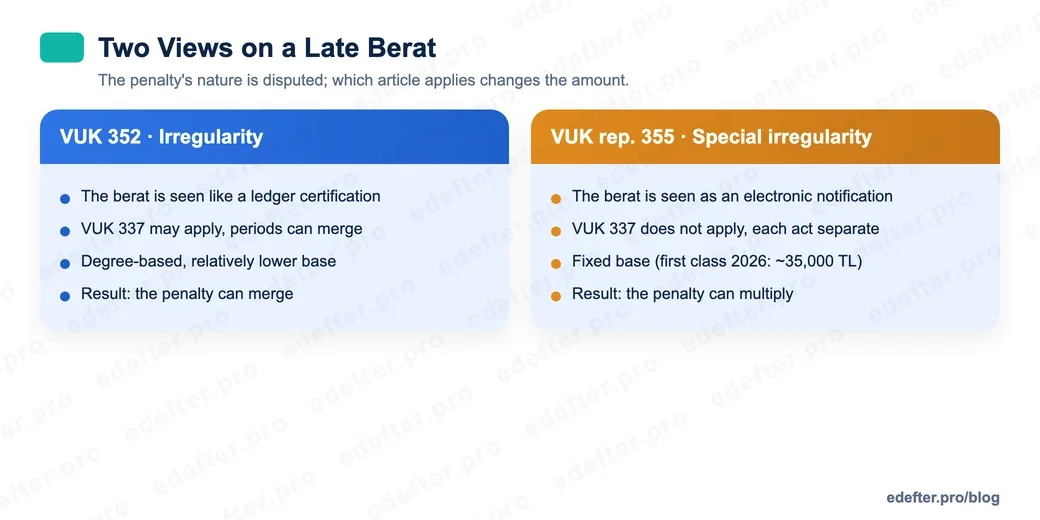
Two different penalty articles are debated for a late berat, and this is the most critical point. The first view likens the berat to a ledger certification and applies the irregularity penalty under VUK 352. The second view treats the berat as an electronic notification and applies the special irregularity penalty under the repeated VUK 355. The difference between the two routes changes both the amount and the "is each period a separate penalty" question.
The table below compares the two views.
| Criterion | VUK 352 (irregularity) | VUK repeated 355 (special irregularity) |
|---|---|---|
| Nature of the berat | Like a ledger certification | Electronic notification/form |
| VUK 337 (single act) | May apply, periods can merge | Does not apply, each act separate |
| Base tendency | Degree-based, relatively lower | Fixed amount, relatively higher |
| Result | Penalty can merge | Penalty can multiply |
Our field observation is this. Tax offices in practice mostly apply repeated 355, but this reading can be taken to court. In Council of State rulings, whether the berat counts as a "notification" is disputed; in some rulings the penalty is annulled, in others upheld. So saying "this exact penalty applies" or "it will definitely be annulled" would be wrong. Assess your own case with your accountant.
What are the 2026 e-Ledger penalty amounts?
The 2026 amounts were set by the Communiqué on the VUK, Serial No. 588 (Official Gazette, 31 December 2025). Which amount applies depends on the article split above. Let us give both routes.
On the irregularity (VUK 352) route, the amount changes with the taxpayer class and the degree. For capital companies, for example, a first-degree irregularity is around 35,000 TL and a second-degree one around 17,000 TL. For first-class merchants and the self-employed, the first degree is around 17,000 TL. In the lower classes the amount steps down.
On the special irregularity (VUK repeated 355) route, a fixed base applies. For capital companies and first-class merchants, the 2026 base is around 35,000 TL. Let us correct a critical mix-up here: this is the base for the non-filing of electronic declarations and notifications. It is not the same as the tiered penalty for not issuing invoices and documents, which rises to much higher ceilings. For taxpayers outside the first class the amounts differ; confirm those lines with the current communiqué and your accountant.
Is a separate penalty charged for each period and each ledger?
The answer to this also depends on the article applied, and it is not absolute. If the repeated 355 reading is taken, because VUK 337 does not apply, each upload period, and even the journal and general ledger berats, may be penalised separately. On a monthly preference, that can run to many separate penalties in a single year.
If the irregularity (VUK 352) reading is taken, the picture changes. VUK 337 may come in, and several periods can be treated as a single or merged penalty. So saying "each period definitely gets a separate penalty" would be wrong; it is a possibility that depends on which view applies.
The lesson here is not the number. The lesson is this: even a single missed period can, in the worst case, turn into a multiplying risk. So prevention is always cheaper than debating the penalty.
How can you reduce an e-Ledger penalty?
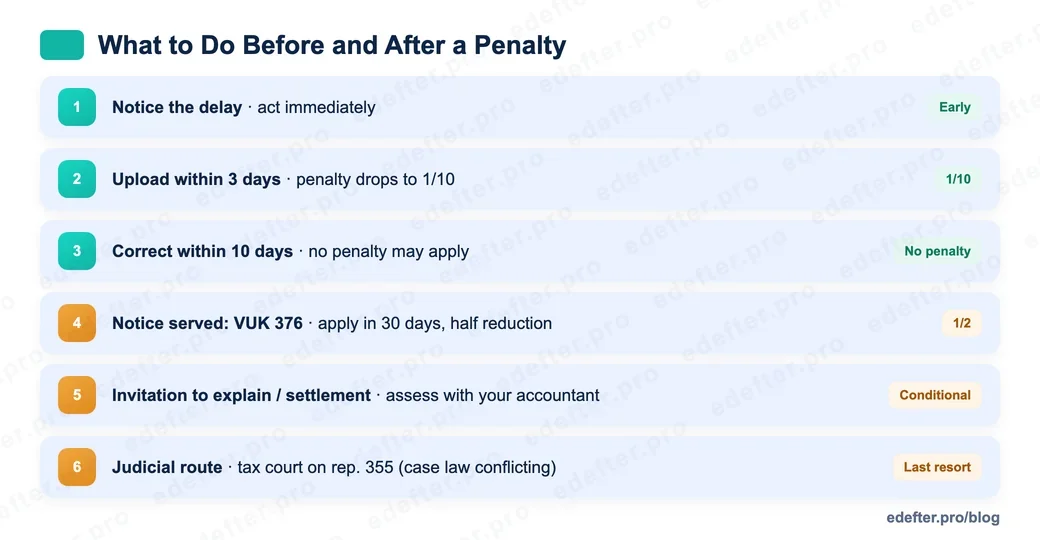
There are routes that work both at the moment of delay and after a notice. The most effective is acting early. For notifications under repeated 355, if the upload is made within the first 3 days after the deadline, the penalty drops to 1/10. If corrected within 10 days of the legal deadline, no penalty may apply. A few days. That is the whole difference.
If the notice has already arrived, other routes come in:
- VUK 376 penalty reduction: If you apply within 30 days of the notice being served, without filing a lawsuit, and commit to payment, a reduction of half comes into play.
- Invitation to explain (VUK 370): Where the conditions are met, a pre-warning mechanism offers a reduced penalty.
- Settlement: A settlement route may come into play for special irregularity penalties. Whether settlement and the VUK 376 reduction can be applied together changed in the legislation, so consult your accountant before choosing one.
- Judicial route: If repeated 355 is charged, a case can be filed at the tax court. As the case law is conflicting, the outcome is not guaranteed.
Which of these routes suits you depends on the type of penalty and your circumstances. Rather than promising a definite outcome, we recommend making a plan with your accountant before a notice arrives. You can find who is within the scope in our transition thresholds guide.
How do you prevent a penalty before it arrives?
The most expensive e-Ledger is the one that gets a penalty. We repeat this in the field, because the penalty can climb far above the annual software cost. Prevention has two legs: not missing the deadline, and not uploading a faulty file.
Two legs, one goal. On the deadline side, the most practical solution is to leave the date to a system, not to memory. At e-Defter PRO we send automatic reminders for upcoming berat dates and check whether the upload was done. On the error side, Schematron and XBRL GL validation before upload catches an inconsistency in the file before it goes to GİB. So both the missed-deadline and the faulty-berat risk fall.
The taxpayer from the opening ended well. We uploaded the berat early, and the penalty window turned in their favour. That was the lesson: act before the penalty arrives, not after.
What Should You Do?
To sum up the penalty in one sentence: the amount is not a single figure, the article is disputed, but an early upload changes everything. If you notice a delay, upload the berat first, then clarify the amount and route with your accountant. If you want to zero out the risk from the start, talk to our expert team.