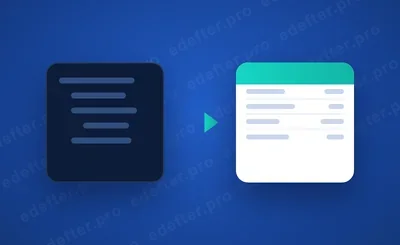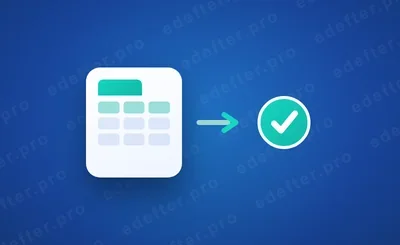

e-Invoice and e-Ledger are two different layers. e-Invoice is the document layer: it turns a single commercial transaction, a sale or a purchase, into an electronic document and sends it to the other party. e-Ledger is the ledger layer: it records all accounting transactions into a legal ledger and gets them approved by GİB, Turkey's Revenue Administration, through a periodic berat. One produces a document. The other turns records into a ledger. They are two separate obligations; neither replaces the other.
Author: e-Defter PRO Content Team. The field team that runs e-Invoice and e-Ledger processes together for taxpayers.
One of the lines we hear most in the field is this. "I already use e-Invoice, do I even need e-Ledger?"
The question looks sensible, but a mix up hides underneath it.
e-Invoice and e-Ledger are not alternatives to each other. They work on two separate layers of accounting. This article sets the difference in the plainest form, shows how they link and clears up the "which one applies to me" question. You can find e-Ledger itself in depth in our what is e-Ledger guide.
What You Need to Know
- e-Invoice is the document layer: it records a single transaction and sends it to the other party.
- e-Ledger is the ledger layer: it turns all records into a legal ledger and gets GİB approval through a periodic berat.
- The two use different formats: e-Invoice uses UBL-TR, e-Ledger uses XBRL GL.
- Using e-Invoice does not remove the e-Ledger obligation; they are separate requirements.
- Invoices are the ledger's input: each invoice becomes a journal entry, and that entry becomes part of the ledger.
What is e-Invoice? The document layer
e-Invoice is the electronic form of a paper invoice, and it records a single commercial transaction. When you make a sale or receive a purchase, the invoice for that transaction is produced electronically, signed and sent to the other party. So e-Invoice tells a single event: a document issued on this date, for this amount, for this good or service.
Its format is an XML structure called UBL-TR. This format carries all the invoice details in a standard order: the parties, the line items, the amounts, the taxes. The document is issued at the moment of the transaction. It does not wait. A sale happens, an invoice is cut, it goes to the other party.
The key word here is "document". e-Invoice does not keep your accounts. It only proves a transaction. Posting that document to your ledger is a separate step.
What is e-Ledger? The ledger layer
e-Ledger is the electronic form of the journal and general ledger that the law requires you to keep. It covers not a single transaction but every accounting movement within a period. Invoices, collections, payments, offsets; all become accounting entries, and those entries are posted to the ledger.
Its format is an international XML standard called XBRL GL, and it differs from the e-Invoice format. e-Ledger works not at the moment of a transaction but periodically. Entries build up, then a berat is produced for each period, and this berat is uploaded to GİB to certify the ledger's existence and integrity. We explained the berat in detail in our what is an e-Ledger berat article.
So e-Ledger is not a document. It is the whole of the records. And that is exactly where the core split from e-Invoice sits.
Let us place the two layers side by side
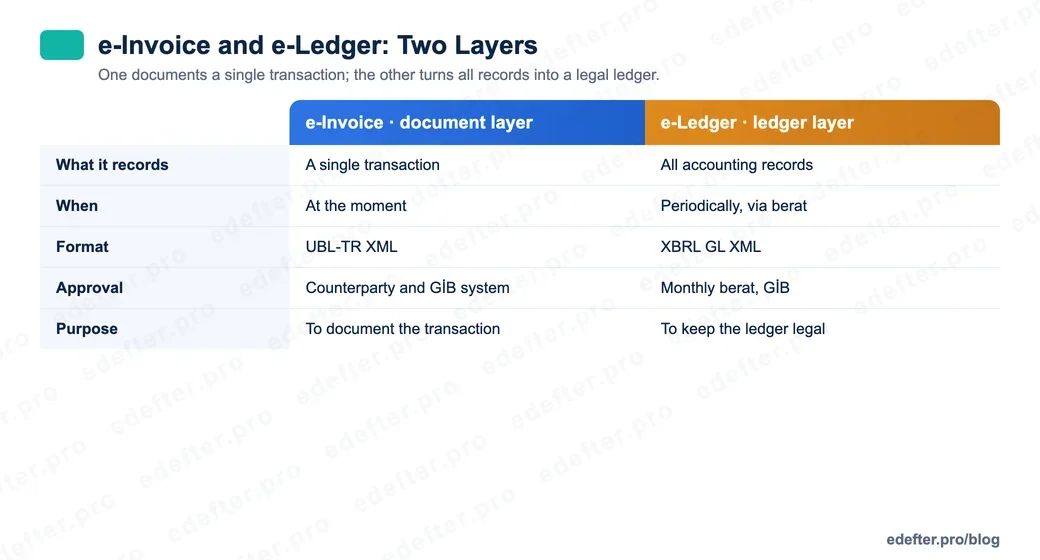
The clearest way to show the difference is to see both in one table. The table below compares e-Invoice and e-Ledger across five dimensions.
| Dimension | e-Invoice (document layer) | e-Ledger (ledger layer) |
|---|---|---|
| What it records | A single transaction | All accounting records |
| When | At the moment | Periodically, via berat |
| Format | UBL-TR XML | XBRL GL XML |
| Approval | Counterparty and GİB system | Monthly berat, GİB |
| Purpose | To document the transaction | To keep the ledger legal |
If we sum the table in one line: e-Invoice documents "what did I sell", e-Ledger answers "what does my ledger say". One is instant, one is periodic; one is single, one is the total.
Is "I use e-Invoice, so I do not need e-Ledger" true?
No. This is a common fallacy. Last month a business owner said exactly that. He had cut e-Invoices for years, and when the e-Ledger transition notice came, he was surprised. "My invoices are already electronic, so my ledger counts too, right?" he said.
It did not count.
Cutting e-Invoices turns your invoices into electronic documents. But posting those invoices to the journal and general ledger, and certifying them to GİB with a periodic berat, is a separate obligation. Being an e-Invoice taxpayer may or may not require you to be an e-Ledger taxpayer; separate criteria decide that. The two systems do not cover each other. Who must use which comes next.
How do e-Invoice and e-Ledger link?
The two layers are separate, yet not disconnected. There is a clear flow between them: the document is the ledger's input. When an invoice is cut, that invoice is an accounting event. In accounting, this event becomes a journal entry. The journal entry is posted to the ledger. At period end, the ledger's berat is produced and uploaded to GİB.
- An e-Invoice is cut or received (a document forms).
- The invoice becomes a journal entry in accounting.
- The journal entry is posted to the journal and general ledger.
- At period end, the ledger's berat is produced and uploaded to GİB.
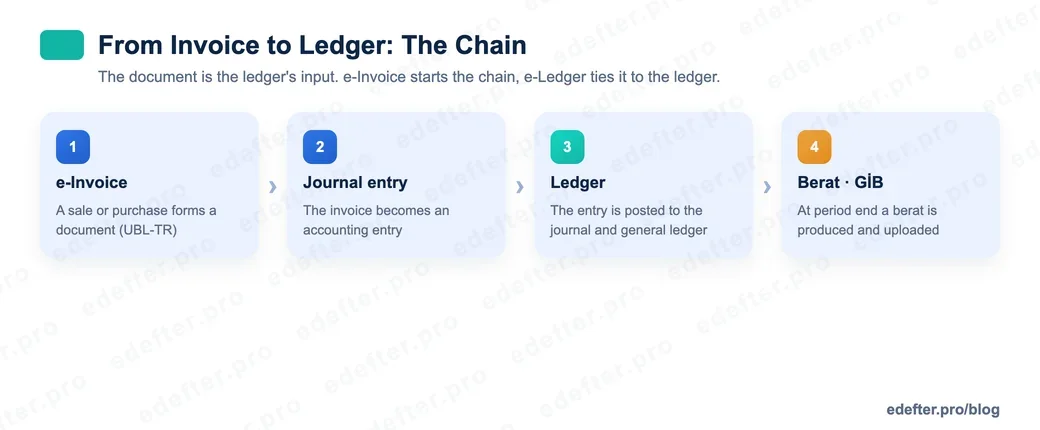
This chain shows why the two layers are separate but linked. e-Invoice starts the chain, e-Ledger ties the chain to a legal ledger. At e-Defter PRO we run that last link, the turning of invoices into a ledger and then a berat.
Which one applies to me?
This is a separate and important question, because the e-Invoice obligation and the e-Ledger obligation rest on different criteria. Turnover thresholds, line of business and taxpayer type are assessed separately for each. Falling into one does not mean you fall into the other.
Rather than repeat the current thresholds and scope on the e-Ledger side, you can find the full detail in our e-Ledger transition thresholds guide. There we cover who must move and when, with sources. For the current e-Invoice criteria, we suggest you confirm from GİB's official announcements.
In Short
Confusing e-Invoice with e-Ledger drags businesses into needless worry and into missed obligations at the same time. Keep them apart: one produces the document, the other turns the record into a ledger. They complete each other; neither stands in for the other. If you want to clear up your road map on the e-Ledger side, talk to our expert team.